

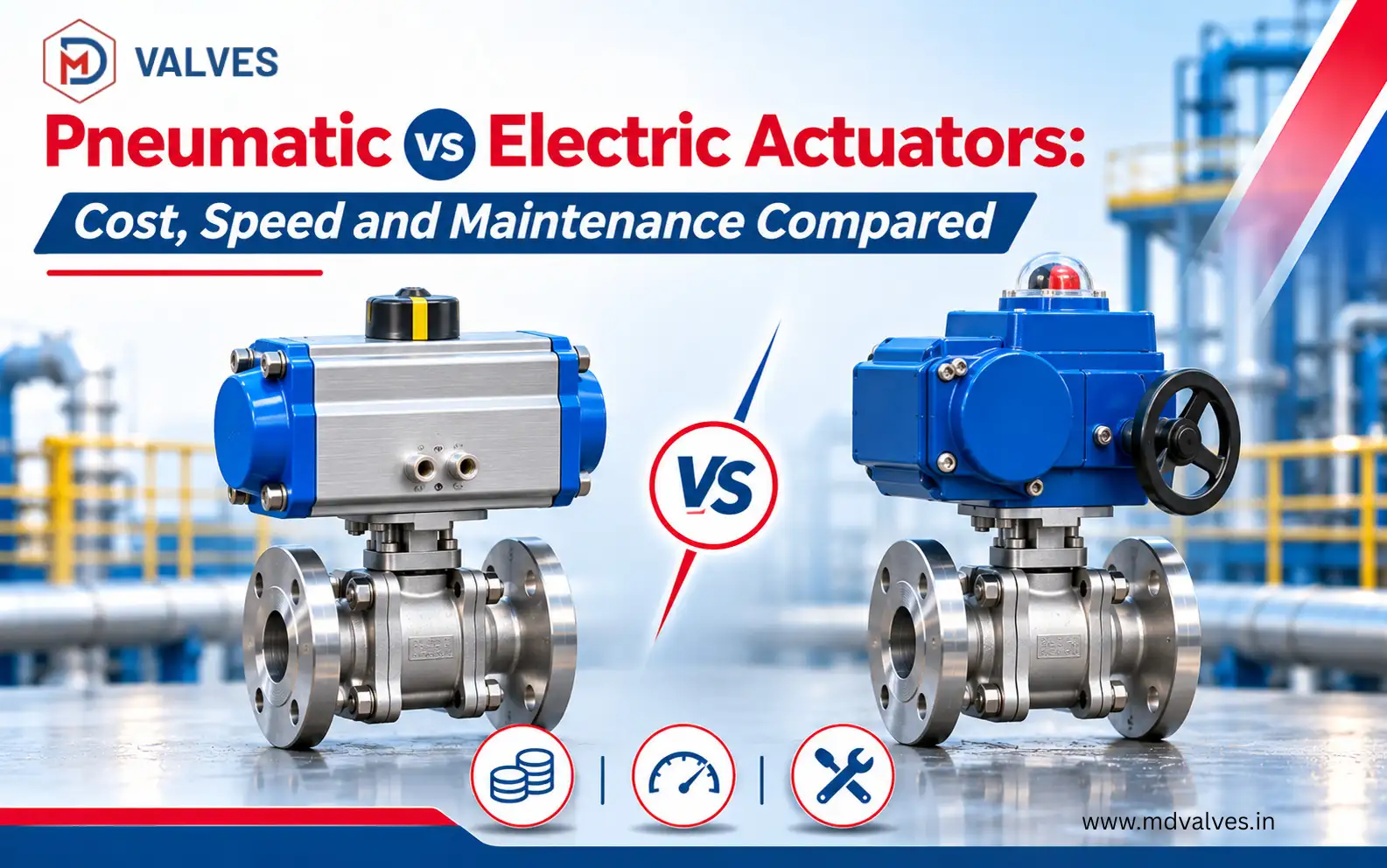
An actuator is the device that opens and closes a valve for you, so nobody has to turn a handwheel. The two most common kinds are pneumatic (driven by compressed air) and electric (driven by a motor). In short, choose pneumatic when you need fast on/off action, automatic fail-safe movement, suitability for hazardous areas, and you already have compressed air. Choose electric when you need precise positioning, or when there is no air supply at the valve. This guide, from MD Valves, a Valve Manufacturer in India that supplies manual, pneumatic and electric valves, explains the difference in simple terms.
How a Pneumatic Actuator Works
Compressed air pushes a piston, or a pair of pistons, which turns or lifts the valve stem. The most common design for quarter-turn valves such as ball valves and butterfly valves is the rack-and-pinion actuator, where the pistons move a toothed rack that turns a gear. For hard-to-turn or large valves, a scotch-yoke actuator gives extra starting torque. For knife edge gate valves and other rising-stem valves, a linear cylinder pushes the stem straight up and down.
Pneumatic actuators come as double-acting (air moves the valve both ways) or spring-return, also called single-acting (air moves it one way and a spring pushes it back). Spring-return is popular because if the air supply fails, the spring moves the valve to a safe position, either open or closed, with no electricity or operator needed.
How an Electric Actuator Works
An electric actuator uses a motor and gearbox to move the valve stem, with limit switches and torque switches that tell it when to stop. For simple on/off duty it moves the valve fully open or closed. For modulating duty it accepts a 4 to 20 mA control signal and holds the valve at any position in between, and it is built to handle frequent small movements. A standard electric actuator does not have automatic fail-safe action, so if you need it, you must add a spring, a battery or a capacitor option, which raises the cost.
Head-to-Head Comparison
Factor | Pneumatic Actuator | Electric Actuator |
| Energy source | Compressed air, typically 4 to 8 bar | Electric power |
| Speed | Fast, often a few seconds or less | Slower, often tens of seconds |
| Fail-safe action | Simple with spring-return | Needs spring, battery or capacitor |
| Precise positioning | Needs a positioner | Excellent |
| Hazardous areas | Naturally suited with correct accessories | Needs certified explosion-proof units |
| Initial cost | Generally lower for quarter-turn valves | Generally higher |
| Running cost | Air generation and leaks | Low |
| Remote sites | Needs air line or local compressor | Needs only a power cable |
What The Comparison Means in Real Plants
Speed matters when a valve must shut quickly in an emergency or cycle many times an hour. A pneumatic actuator moves in seconds, which is why it dominates batching, dust collection and safety shut-off. A slower electric actuator is not always a disadvantage: when you fill a tank or protect a pipeline from water hammer, slow, controlled movement is actually what you want.
Cost has two parts. A pneumatic unit costs less to buy, especially if the plant already has a compressed air network. But if there is no air system, adding compressors, dryers and piping can wipe out the saving. Compressed air is also an expensive utility, and leaks are commonly estimated to waste a meaningful share of what the compressor produces, so air lines need regular checking. An electric actuator costs more at the start but uses power only while it is moving and needs less supporting equipment.
Control accuracy is where electric units shine. If you need to hold a valve at 40 or 65 percent open to control flow or level, an electric modulating actuator does it with simple wiring. A pneumatic actuator can also do it, but it needs a positioner and a clean, steady air supply.
Hazardous areas, such as places with coal dust, solvents or gas, favour pneumatic actuators, because the moving part runs on air and there is no spark risk at the actuator. Electric actuators can be used there too, but they must be certified for the area, which costs more.
Sizing: The Step Many Buyers Skip
An actuator must produce more torque (or force) than the valve needs in the worst case. The worst case is usually full line pressure plus extra friction from packed solids or an aged seat. A common practice is to add a safety margin of roughly 25 to 30 percent, and more for slurry or dirty service. Also check the air pressure: an actuator sized for 6 bar will fall short if the plant air drops to 4 bar. For spring-return units, the spring end of the stroke often gives the lowest torque, so check both ends. Finally, make sure the valve and actuator share the same mounting standard (ISO 5211 is common), and that the solenoid valves and limit switches follow the NAMUR interface, so parts fit together. Match the actuator to the valve's pressure class too, using Valve Pressure Ratings Explained.
Accessories That Make an Actuator Work Properly
Most automated valves need a few extras. A solenoid valve switches air to the actuator from a control signal. A limit switch box tells the control system whether the valve is open or closed. A positioner allows modulating control on a pneumatic actuator. An air filter regulator keeps the air clean, dry and at the right pressure, which is the biggest single factor in pneumatic actuator life. And a manual override lets operators move the valve if power or air fails.
Maintenance in Practice
For pneumatic actuators, drain the filters, check regulator pressure, look for leaks in tubing and fittings, and inspect seals and grease as the maker advises. For electric actuators, check wiring and terminals, gearbox lubrication, limit and torque switch settings and the enclosure seals. If an automated valve starts leaking, check the actuator settings first, as explained in 7 Common Causes of Valve Leakage.
Which Should You Choose?
If you run a cement, mining or dusty plant with compressed air available, pneumatic is usually the natural fit. If you need an emergency shut-off that closes by itself on air failure, pick a pneumatic spring-return unit. If the pipeline is remote and has no air, go electric. If you need accurate flow or level control, electric (or pneumatic with a positioner) is better. For very large, high-torque valves, compare both against the utilities you have on site.
Mistakes to Avoid
The most common are sizing the actuator for clean-water torque on a slurry valve, ignoring the lowest plant air pressure, using an on/off electric actuator for modulating control, forgetting manual override, and buying the valve and actuator from different sources with mismatched mounting.
Valve and Actuator From one Source
When the valve and the actuator come from the same supplier, torque sizing, mounting and testing are handled together, so you avoid mismatches. MD Valves supplies actuated valves, including knife gate, butterfly and ball valves with pneumatic and electric actuation, from Ahmedabad. Browse the actuated valve range, then share your valve size, media, pressure, air or power supply and control signal for a recommendation.
- Talk to an expert: +91 9664718881 or +91 91067 77653
- Email: info@mdvalves.in
- Request a quote | Download our catalogue
Frequently Asked Questions
Is a pneumatic or electric actuator cheaper?
Pneumatic is generally cheaper to buy for quarter-turn valves, especially where compressed air already exists.
Which actuator is faster?
Pneumatic actuators are usually much faster than electric ones.
Can electric actuators provide fail-safe operation?
Yes, with a spring, battery or capacitor option, though it adds cost and complexity.
Which is better for modulating control?
Electric actuators, or pneumatic actuators fitted with a positioner, depending on the accuracy needed.
How much safety margin should I add when sizing an actuator?
A common practice is about 25 to 30 percent over the valve's maximum torque, and more for slurry or dirty service.