

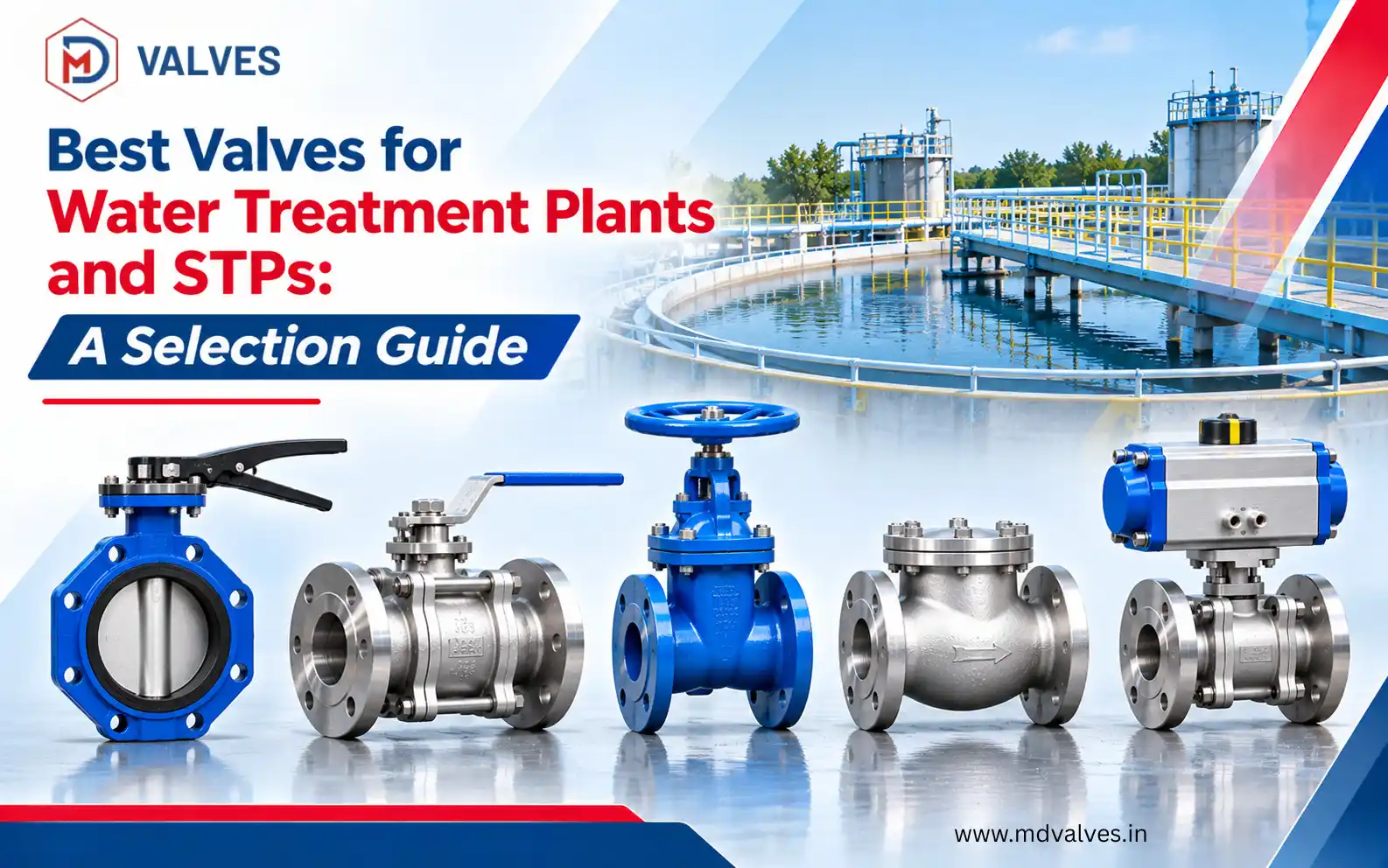
A water treatment plant or sewage treatment plant (STP) is not one pipeline. It is many different pipelines carrying very different things: clean water, raw water with silt, thick sludge, corrosive chemicals and air. That is why no single valve works everywhere. In short, butterfly valves are used for large water lines, gate valves for isolation, knife edge gate valves for sludge and wastewater with solids, check valves to protect pumps, and ball valves for small chemical lines. This guide, from MD Valves, a Valve Manufacturer in India, explains where each valve goes, why, and how to choose materials and automation.
Which Valve Goes Where
The table below is a quick map of the plant. The sections after it explain the reasoning.
Plant stage | What flows | Recommended valve |
| Raw water intake and mains | Raw water, silt | Butterfly or gate valve |
| Screening and grit (STP) | Sewage with solids | Knife gate valve |
| Chemical dosing | Alum, chlorine, caustic, polymer | Ball valve in compatible material |
| Clarifier and sludge withdrawal | Thick sludge | Knife gate valve |
| Filter inlet, outlet and backwash | Clean water | Actuated butterfly valve |
| Aeration blower air (STP) | Air | Butterfly valve |
| Pump discharge | Treated water or effluent | Check valve plus isolation valve |
| Treated water distribution | Potable water | Butterfly or gate valve |
Butterfly Valves: The Workhorse for Water
Butterfly valves are light, compact and cost-effective in large diameters, so they dominate filter galleries, pumping stations and water mains. The usual design has a concentric disc with an EPDM rubber liner, which suits clean water very well. For waterworks, valves commonly follow standards such as AWWA C504 or EN 593, so check which one your tender asks for. Their limits are that the disc always sits in the flow, which causes some pressure drop, and that grit-laden water wears the disc and liner faster. Our butterfly valve range covers these water applications.
Gate Valves: Full-Bore Isolation
A gate valve lifts a wedge or gate out of the flow path, so when it is open the water passes straight through with very little loss. In India, resilient-seated gate valves for waterworks are often called sluice valves, and tenders commonly refer to IS 14846, so confirm the current standard in your documents. They are meant for isolation, used occasionally, and are slow to operate. They should not be used to throttle flow.
Knife Edge Gate Valves: The Answer For Sludge
Sludge, scum, grit and thick wastewater are where ball and butterfly valves fail. Solids pack into cavities, wrap around the disc and stop the valve from closing. A knife edge gate valve solves this because its sharp blade cuts through the solids and its straight-through body leaves no pocket for them to collect. That is why it is the standard choice on return and waste sludge lines, digester lines and dewatering feed lines.
Check Valves: Protecting The Pumps
When a pump stops, water tries to flow backwards. A check valve closes automatically to stop this and protect the pump. The type matters. A swing check valve is simple but can slam shut and cause a pressure surge. A dual-plate (wafer) check valve is compact and closes faster. A nozzle or non-slam check valve closes before the flow reverses, which makes it the best choice for reducing water hammer on larger pumping mains.
Ball Valves: Small Lines and Chemicals
Ball valves give tight shut-off in a small package, which suits chemical dosing lines, sampling points and instrument isolation. The main selection issue is chemical compatibility: the body and seat must resist the chemical being handled.
Choosing Materials That Last
For clean water, cast iron or ductile iron bodies with an epoxy coating and EPDM seats are the common choice. Carbon steel (WCB) is used where pressure or temperature is higher, and stainless steel (SS304 or SS316) where media are corrosive or the valve is outdoors. For aggressive chemicals such as hypochlorite, PVC, CPVC or PTFE-lined valves are often preferred. NBR seats suit oils and greases but not strong oxidisers, while Viton and PTFE handle tougher chemicals and higher temperatures.
Two points matter especially in this industry. First, sewage produces hydrogen sulphide (H2S), which attacks uncoated metal quickly, so STPs need protective coatings or stainless steel. Second, chlorides can cause pitting in SS304, so SS316 or better is the safer choice in chlorinated or brackish water. For drinking water, ask for material compliance such as NSF/ANSI 61 or your local requirement.
Water Hammer and Surge
Pump trips and fast valve closure create pressure spikes that damage seats, joints and pipes. Use slow-closing valves, non-slam check valves and surge vessels where needed, and make sure the valve pressure rating covers the surge. Valve Pressure Ratings Explained shows how to estimate it.
Automation in Treatment Plants
Plants run all day with few operators, so automation improves consistency and safety. Filter backwash sequences and tank isolation are well served by on/off pneumatic or electric actuators. Flow or level control needs electric modulating actuators with 4 to 20 mA signals. For SCADA, every automated valve should carry limit switches or position feedback.
Questions to Answer Before Ordering
Ask yourself what the media is and how many solids it carries, what the line pressure and surge are, what pipe size and flange standard you have, how often the valve will operate, whether it is potable water, sewage or chemical, and whether the valve will be buried, submerged or outdoors, because that decides coating and stem extension.
Mistakes to Avoid
The common ones are using butterfly or ball valves on thick sludge, ignoring H2S corrosion in STPs, installing swing check valves on large pumping mains without a surge check, choosing seat material without checking the chemical, and forgetting a manual override on automated valves.
Valves for Treatment Plants From MD Valves
MD Valves is an Ahmedabad-based Valve Manufacturer in India supplying manual, pneumatic and electric valves, including knife gate valves for sludge and wastewater and actuated valves for plant automation. Share your plant stage, media, size, pressure and control requirements, and our engineers will recommend suitable valves and send a quotation within 24 hours.
- Talk to an expert: +91 9664718881 or +91 91067 77653
- Email: info@mdvalves.in
- Request a quote | Download our catalogue
Frequently Asked Questions
Which valve is most common in water treatment plants?
Butterfly valves are the most common in large water lines because of their size range, low weight and cost.
What valve is best for sludge?
Knife gate valves handle sludge and solids-laden wastewater well, because the blade cuts through solids and there is no cavity to clog.
Which seat material is used for water service?
EPDM is widely used, but always check compatibility with your media and temperature.
Why do STP valves corrode quickly?
Sewage produces hydrogen sulphide, which attacks uncoated metals. Coated or stainless steel valves last longer.
Should treatment plant valves be automated?
Often yes, especially for filter operation, remote locations and lines that cycle frequently.