

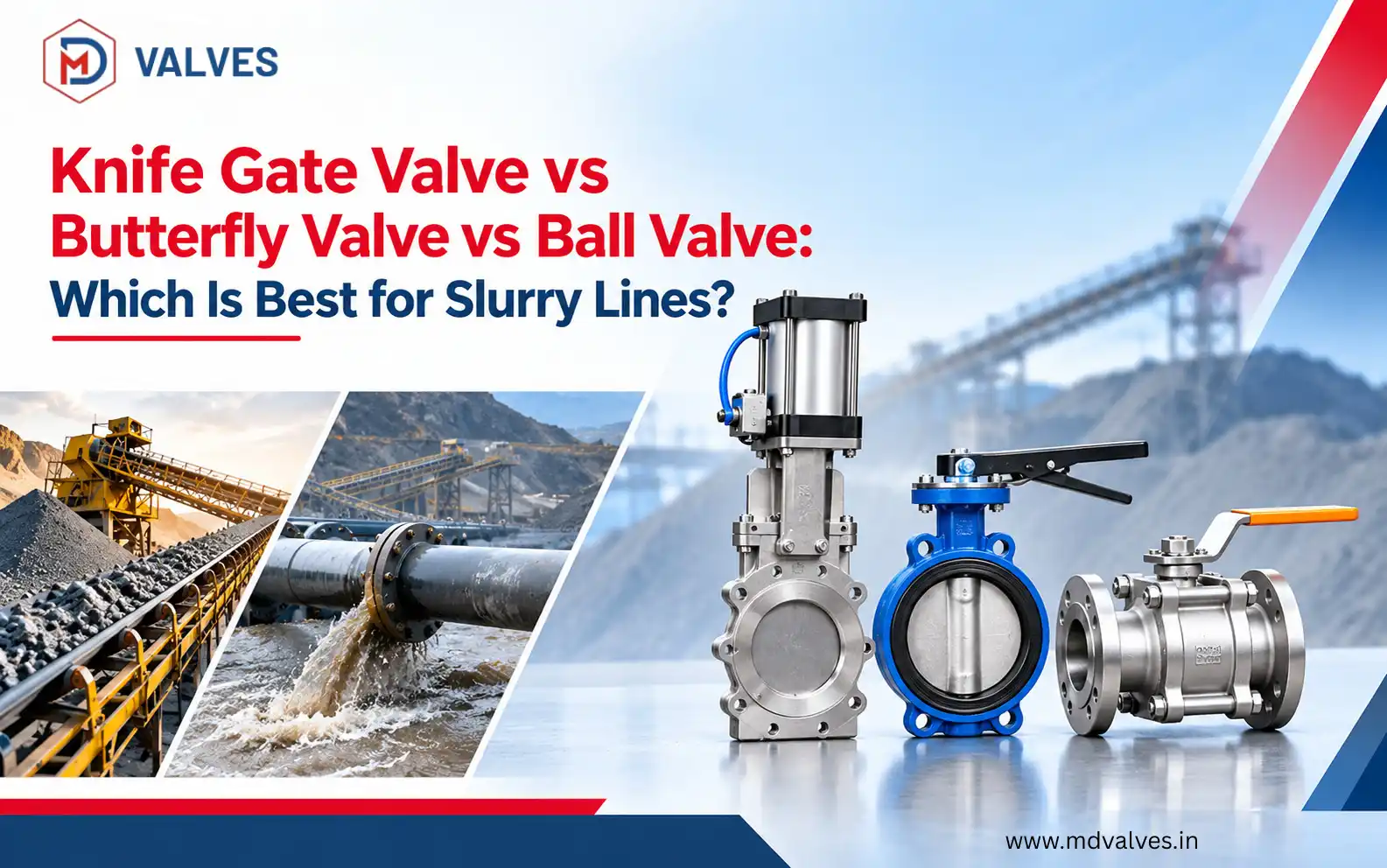
If your pipeline carries slurry, the valve you choose decides how often you stop the plant for repairs. In most cases a knife gate valve is the best choice for thick, abrasive or fibrous slurry. A butterfly valve works for light slurry with small amounts of solids, and a ball valve is better kept for clean or lightly dirty liquids. This guide explains why, in plain language, so you can choose with confidence. It comes from MD Valves, a Valve Manufacturer in India that regularly supplies valves for mining, cement and wastewater lines.
What Makes Slurry So Hard on Valves
A slurry is simply a liquid carrying solid particles, such as sand in water, ash in water, ore fines in a mining line or sludge in a sewage plant. Four things decide how rough it is on a valve.
The first is how much solid it carries. A line with 5 percent solids is gentle compared with one carrying 40 percent. The second is what the particles are like. Sharp, hard particles such as silica sand act like sandpaper and cut through rubber and metal quickly, while soft or rounded particles do much less damage. The third is speed. As a rule of thumb, slurry lines are run at around 1.5 to 3 metres per second. Slower than that and the solids settle and block the line, faster than that and the pipe and valve erode quickly. The fourth is chemistry and temperature, because acidic, alkaline or hot slurry also attacks seats and seals.
These conditions cause four typical problems. Seats and discs get ground down by sliding particles (abrasion). Flow hits the closing part at speed and eats into it (erosion). Solids pack into any gap or pocket inside the valve and stop it from closing fully. And deposits build up on moving parts and make the valve stiff. A good slurry valve is one that limits all four, and that is the test we use for the three valves below.
The Knife Gate Valve: Made For Solids
A knife edge gate valve has a thin, sharp-edged metal blade that slides across the pipe to close it. When the blade comes down, it cuts through thick material, fibres and packed solids instead of getting stuck on them. When it is open, the flow runs straight through the body with almost no pocket where solids can collect.
A few parts decide how well it performs. The blade is usually stainless steel, and in abrasive duty it can be hardened or coated for longer life. The seat can be a soft material such as EPDM, NBR or polyurethane, which gives a tight seal, or a metal seat, which tolerates heat and heavy wear but allows a small amount of leakage. The packing seals the point where the blade leaves the body, and it is the part you will adjust or replace most often. The valve can also be uni-directional (seals best in one flow direction) or bi-directional (seals both ways), so you should tell your supplier which one your line needs.
Knife gate valves have two limits you must respect. They are designed for fully open or fully closed duty and should not be used to throttle flow, because a partly open blade wears quickly. And standard designs are generally used at low to moderate pressure, commonly around 10 bar, with lower limits in very large sizes. For normal slurry, tailings, sludge and wastewater lines, these limits are rarely a problem.
The Butterfly Valve: Economical, But The Disc is Always in The Flow
A butterfly valve closes by turning a round disc on a shaft inside the pipe. It is light, compact, cheap in large sizes, quick to operate and easy to automate, which is why it is so popular for water. The weakness in slurry is that even when the valve is fully open, the disc still sits in the middle of the flow, so it takes the full beating from the particles. Solids also collect around the disc edge and the shaft, which raises the torque needed to turn it and stops it from sealing.
The common type has a rubber-lined seat, which is fine for water and light slurry but wears fast with abrasive particles. Metal-seated double or triple offset designs handle higher pressure and temperature, but they too are limited by disc wear in heavy slurry. So use a butterfly valve when the slurry is thin and the solids are small and soft, such as silty water. Our butterfly valve range covers these light-duty applications.
The Ball Valve: Great Seal, Wrong Shape for Solids
A ball valve has a ball with a hole through it. It gives excellent, tight shut-off, and a full-bore version has very little pressure drop. The problem in slurry is the cavity around the ball. When the valve closes, some slurry stays trapped inside the body, the solids settle and harden there, and the ball starts to jam or scratch the seat. Standard soft seats also wear out quickly in abrasive media. Special slurry ball valves with ceramic lining or hardened balls do exist, but they cost much more than a knife gate valve of the same size. For most plants, ball valves make sense only where the fluid is clean or only lightly contaminated.
Side-by-side Comparison
Feature | Knife gate valve | Butterfly valve | Ball valve |
| Thick or fibrous slurry | Excellent | Poor | Poor to fair |
| Abrasion resistance | Good with a hardened blade | Fair | Fair |
| Risk of trapped solids | Very low | Medium | High |
| Tight shut-off | Good with a soft seat | Good | Excellent |
| Throttling | Not recommended | Yes | Limited |
| Pressure capability | Low to moderate | Moderate | High |
| Cost in large sizes | Low | Low | High |
How to Decide For Your Line
Think about what your pipeline actually carries. For mining tailings, sewage sludge, paper pulp or thick cement slurry, use a knife gate valve, because these contain heavy solids or fibres that would jam anything else. For fly ash slurry or other abrasive mineral slurry, a knife gate valve with a hardened blade and a suitable seat is again the safest option. For water with some sand or silt, or thin effluent, a butterfly valve is usually enough and costs less. For clean process water, chemical dosing or small isolation lines, a ball valve gives the best sealing.
If the valve will open and close often, or sits in a hard-to-reach place, add an actuator. Slurry lines are dirty, and automation saves operators from working near them. Read Why Pneumatic Actuators Are Ideal for Industrial Valve Automation to decide.
Mistakes That Cost Plants Money
The most common mistake is choosing a butterfly valve for thick slurry only because it is cheaper, and then replacing seats every few weeks. Others are ignoring how hard the particles are when picking the seat, using a ball valve where solids can pack the cavity, using a knife gate valve to throttle flow, and fitting an actuator that is too small to push the blade through packed solids. Another is forgetting flow direction on a uni-directional valve. A valve that costs a little more but runs for years is always cheaper than one that stops the plant.
Installation and Upkeep
Install the valve with the flow in the direction its seat was designed for, and leave space around the gland and actuator so packing can be adjusted. Where solids can build up behind the blade, a flush or purge connection helps. Operate rarely used valves from time to time so they do not seize, and keep spare seats and packing for critical lines.
What to Tell Your Supplier
For an accurate recommendation and quote, share the type of slurry and percentage of solids, particle size and hardness, pipe size and flange standard, line pressure and temperature, flow direction, how often the valve operates, and whether you want manual, pneumatic or electric operation.
Get the Right Valve From MD Valves
MD Valves is an Ahmedabad-based Valve Manufacturer in India supplying manual, pneumatic and electric valves for mining, cement, wastewater and process industries. Our engineering and sales team reviews your media, pressure and duty details, recommends the right valve and actuator, and sends a quotation within 24 hours.
- Talk to an expert: +91 9664718881 or +91 91067 77653
- Email: info@mdvalves.in
- Request a quote | Download our catalogue | About MD Valves
Frequently Asked Questions
Which valve is best for abrasive slurry?
A knife gate valve with a hardened blade and a seat suited to the particle type is usually the best option.
Can a butterfly valve be used for slurry?
Yes, for light and low-abrasion slurry. Heavy or fibrous slurry wears the disc and seat quickly and raises torque.
Are ball valves suitable for slurry?
Standard ball valves are not, because solids collect in the cavity. Only specially designed slurry ball valves should be considered.
Can knife gate valves be used for throttling?
No. They are designed for fully open or fully closed duty. Use a control valve if you need to regulate flow.
Can knife gate valves be automated?
Yes, with pneumatic, electric or hydraulic actuators.