
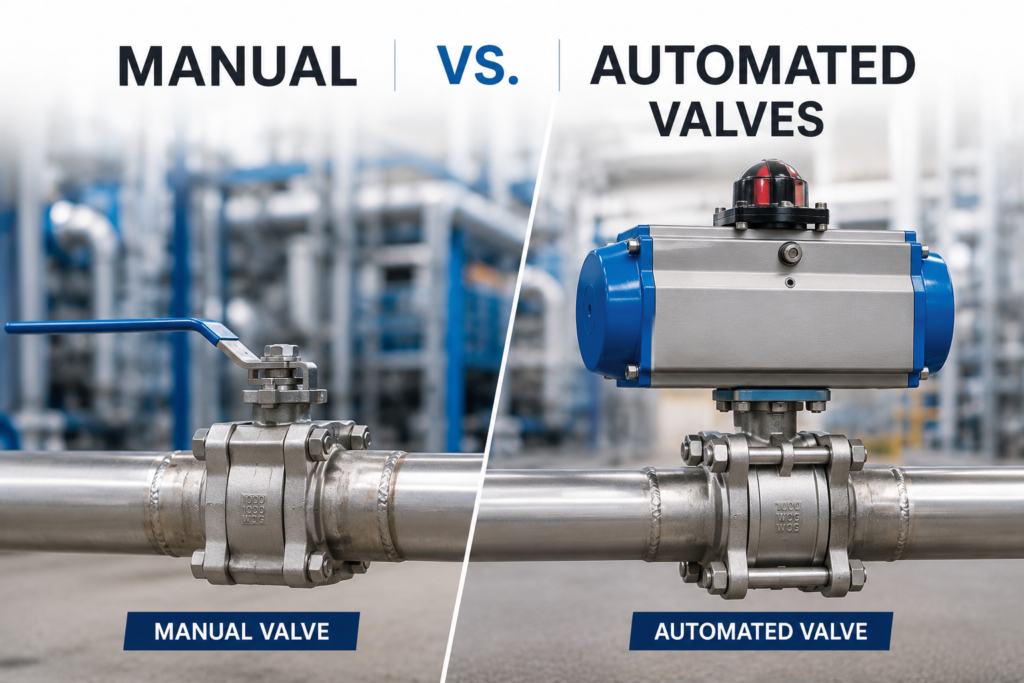
Selecting the right industrial valve is about much more than simply controlling the flow of liquids or gases. The choice between manual vs automated valves directly affects your plant’s efficiency, operating costs, process safety, maintenance requirements, and long-term productivity.
While manual valves are known for their affordability, simplicity, and dependable performance, automated valves deliver intelligent flow control, remote operation, and seamless integration with modern industrial automation systems. Each option has unique advantages, and choosing the wrong valve can lead to unnecessary maintenance, higher labour costs, production downtime, and reduced operational efficiency.
Whether you’re designing a new process plant, upgrading an existing pipeline, or planning an automation project, understanding the difference between manual and automated valves is essential.
In this guide, you’ll learn:
- What manual and automated valves are
- The key differences between both valve types
- Cost comparison and return on investment
- Advantages and disadvantages
- Industry-wise applications
- Maintenance requirements
- How to select the right valve for your process
- Frequently Asked Questions
By the end of this guide, you’ll be able to confidently choose the best industrial valve solution for your application.
What is a Manual Valve?
A manual valve is operated by hand using a handwheel, lever, gear operator, or chain wheel. The operator physically opens, closes, or regulates the flow without the need for electrical, pneumatic, or hydraulic power.
Manual valves have been widely used across industries for decades because of their reliability, low maintenance, and economical installation costs.
Common Types of Manual Valves
- Ball Valve
- Butterfly Valve
- Gate Valve
- Globe Valve
- Plug Valve
- Knife Gate Valve
- Check Valve (non-operated)
Best Applications
- Water distribution
- Chemical plants
- Utility pipelines
- Isolated process lines
- Maintenance bypass systems
- Low-frequency operations
What is an Automated Valve?
An automated valve is operated using an actuator instead of manual effort. The actuator can be pneumatic, electric, or hydraulic, allowing the valve to open, close, or modulate automatically.
Automated valves are commonly integrated with PLC, DCS, and SCADA systems for remote monitoring and process automation.
Components of an Automated Valve
- Industrial valve
- Pneumatic actuator
- Electric actuator
- Hydraulic actuator
- Solenoid valve
- Positioner
- Air Filter Regulator (AFR)
- Limit switch box
Automation eliminates manual intervention while improving process accuracy and operational efficiency.
Key Differences Between Manual and Automated Valves
The primary difference lies in how the valve operates.
Manual valves require an operator to physically turn the valve whenever flow needs adjustment. Automated valves respond instantly to electrical signals, air pressure, or hydraulic systems.
Other major differences include:
- Remote accessibility
- Process accuracy
- Response time
- Safety
- Labour requirements
- Automation compatibility
- Productivity
Automated valves are particularly valuable where frequent operation or continuous monitoring is required.
Advantages of Manual Valves
Manual valves continue to be a preferred solution in many industrial applications due to their simplicity.
Lower Initial Investment
Manual valves are significantly less expensive than automated systems because no actuator or control accessories are required.
Easy Installation
Installation is straightforward with minimal wiring or instrumentation.
Minimal Maintenance
With fewer moving parts, manual valves typically require less maintenance.
Reliable During Power Failures
Manual valves operate independently of electricity or compressed air, making them dependable during emergencies.
Longer Service Life
Properly maintained manual valves often provide years of reliable service in less demanding applications.
Advantages of Automated Valves
Automated valves have become the preferred choice for modern process industries seeking greater efficiency and productivity.
Remote Operation
Operators can control valves from a central control room without visiting the installation site.
Faster Response
Automated valves respond within seconds, improving process control.
Improved Accuracy
Positioners ensure precise valve movement, reducing process variations.
Reduced Labour Costs
Automation eliminates repetitive manual operations and reduces manpower requirements.
Increased Plant Safety
Operators avoid hazardous environments, improving workplace safety.
Smart Integration
Automated valves integrate with:
- PLC Systems
- SCADA
- DCS
- Industrial IoT
- Smart Manufacturing
Disadvantages of Manual Valves
Despite their advantages, manual valves have certain limitations.
- Labour intensive
- Cannot be remotely operated
- Slower response during emergencies
- Operator-dependent accuracy
- Difficult to operate large valves
- Not suitable for continuous automation
Disadvantages of Automated Valves
Automation also has some considerations.
- Higher purchase cost
- Requires power or compressed air
- More components to maintain
- Skilled technicians needed
- Higher installation complexity
However, these costs are often recovered through improved productivity and reduced operating expenses.
Performance Comparison
When comparing performance, automated valves outperform manual valves in most demanding industrial applications.
Manual Valves
- Suitable for occasional operation
- Slower response time
- Dependent on operator skill
- Limited precision
Automated Valves
- Consistent operation
- High-speed response
- Accurate positioning
- Continuous process control
- Suitable for 24/7 production
Maintenance Requirements
Maintenance depends on operating conditions and service frequency.
Manual Valves
Routine maintenance generally includes:
- Lubrication
- Stem inspection
- Packing replacement
- Leak inspection
Automated Valves
Additional maintenance includes:
- Actuator servicing
- Solenoid valve inspection
- Positioner calibration
- Air filter replacement
- Electrical connection checks
Preventive maintenance significantly increases the lifespan of automated valve systems.
Safety Comparison
Safety is one of the biggest reasons industries adopt automation.
Manual Valves
Operators may need to enter:
- High-temperature areas
- Hazardous chemical zones
- Elevated platforms
- Confined spaces
Automated Valves
Automation allows valves to be operated remotely, reducing human exposure to hazardous environments while improving emergency response capabilities.
Energy Efficiency
Modern automated valves contribute to better energy management by maintaining accurate flow control and minimizing unnecessary pressure losses.
Benefits include:
- Optimized fluid flow
- Reduced compressed air consumption (with efficient pneumatic systems)
- Improved pump efficiency
- Lower energy wastage
- Better process stability
Manual valves, while not consuming external power, rely on manual intervention and may not maintain optimal operating conditions consistently.
Valve Automation Technologies
Several actuator technologies are available depending on process requirements.
Pneumatic Actuators
- Fast operation
- Ideal for process industries
- Reliable in hazardous environments
- Cost-effective
Electric Actuators
- Precise positioning
- Suitable where compressed air is unavailable
- Easy integration with automation systems
Hydraulic Actuators
- High torque output
- Designed for large industrial valves
- Used in heavy-duty applications
Selecting the right actuator depends on valve size, operating torque, available utilities, and control requirements.
Best Industries for Manual Valves
Manual valves remain an excellent choice in applications where valve operation is infrequent or automation is unnecessary.
Common industries include:
- Water supply systems
- Irrigation
- Building services
- Fire protection systems
- Small manufacturing units
- Utility pipelines
- HVAC systems
- Maintenance isolation lines
Best Industries for Automated Valves
Automated valves are widely used in industries requiring precise process control and continuous operation.
They are commonly installed in:
- Oil & Gas
- Chemical Processing
- Petrochemical Plants
- Pharmaceutical Manufacturing
- Food & Beverage Processing
- Water & Wastewater Treatment
- Power Generation
- Pulp & Paper
- Steel Plants
- Cement Industry
- Refineries
- Marine Applications
These industries benefit from improved efficiency, safety, and remote monitoring capabilities.
How to Choose the Right Valve
Selecting the right valve depends on several technical and operational factors.
Consider the following before making a decision:
- Frequency of valve operation
- Required level of automation
- Process pressure and temperature
- Fluid type
- Installation environment
- Available power or air supply
- Safety requirements
- Budget
- Maintenance capability
- Future expansion plans
For simple applications with occasional use, manual valves are often sufficient. For critical processes requiring speed, precision, and remote control, automated valves are the preferred solution.
Why More Industries Are Switching to Valve Automation
Industrial facilities are increasingly investing in valve automation as part of their digital transformation initiatives.
Key reasons include:
- Reduced operational costs
- Improved production efficiency
- Enhanced worker safety
- Real-time monitoring
- Predictive maintenance
- Better process consistency
- Lower downtime
- Integration with Industry 4.0 technologies
- Increased plant reliability
As industries move toward smart manufacturing, automated valves are becoming an essential component of modern process control systems.
Why Choose MD Valves?
At MD Valves, we provide high-quality industrial valve solutions designed to meet the demands of modern industries. Our comprehensive product range includes Manual vs Automated valves manufactured to deliver reliable performance, long service life, and efficient flow control.
Our offerings include:
- Ball Valves
- Butterfly Valves
- Gate Valves
- Globe Valves
- Knife Gate Valves
- Control Valves
- Pneumatic Actuated Valves
- Electric Actuated Valves
- Pneumatic Actuators
- Electric Actuators
- Solenoid Valves
- Valve Automation Accessories
With a focus on quality, precision engineering, and customer satisfaction, Alis Valves serves industries such as oil & gas, chemicals, pharmaceuticals, water treatment, food processing, power generation, and many more. Whether you need a standard manual valve or a fully automated valve package, our team can help you select the right solution for your application.
Frequently Asked Questions
Which is better: manual or automated valves?
Neither is universally better. Manual valves are ideal for simple, low-frequency applications, while automated valves are better suited for continuous, remote, and precision-controlled operations.
Are automated valves worth the investment?
Yes. Although they have a higher upfront cost, automated valves often provide significant savings through reduced labour, lower downtime, and improved process efficiency.
Which industries benefit the most from automated valves?
Industries such as oil & gas, chemical processing, pharmaceuticals, food processing, power generation, and wastewater treatment benefit greatly from valve automation.
Do automated valves require regular maintenance?
Yes. In addition to standard valve maintenance, actuators, solenoid valves, positioners, and control accessories should be inspected and serviced periodically for reliable performance.
Can existing manual valves be automated?
In many cases, yes. Existing manual valves can often be retrofitted with pneumatic or electric actuators, provided the valve design and operating conditions are suitable.
Which actuator is best: pneumatic or electric?
Pneumatic actuators are preferred for fast operation and hazardous environments, while electric actuators are ideal for precise positioning and locations without compressed air.
Conclusion
Choosing between manual and automated valves ultimately depends on your process requirements, operational goals, and long-term investment strategy. Manual valves remain a practical and economical choice for applications with infrequent operation and straightforward flow control. In contrast, automated valves provide superior efficiency, precision, safety, and remote operation, making them indispensable for modern industrial facilities.
As industries continue to embrace automation and Industry 4.0, the demand for intelligent valve systems is rapidly increasing. Investing in the right valve solution today can lead to lower operating costs, improved reliability, and greater productivity in the years ahead.
Whether you’re upgrading an existing pipeline or designing a new process plant, partnering with an experienced valve manufacturer like MD Valves ensures you receive high-quality manual and automated valve solutions tailored to your specific industrial application.